Introduction
This is a reflective essay on writing histories and geographies of place. It is – and probably will remain – unpublished and available on a personal website. So it is a work in progress, thoughts ongoing, likely to be updated.
So it is fitting that I start with two other unpublished essays, one mine, that shape this piece.
Dan Frost kindly agreed to host the Q and A for the launch of my new book, Contested Commons, at Housmans Bookshop in London in January 2026. His first question was what had inspired me to write it. My honest answer was the late radical geographer Doreen Massey, and in particular, her unpublished essay from 2010, “Landscape/Space/Politics”, available on a wordpress site.
Massey wrote it as part of a 2010 AHRC research project on landscapes and in response to one of the project’s outputs, Robinson in Ruins, the third in the Robinson trilogy of films by Patrick Keiller. I must confess I hadn’t seen Keiller’s work at the time.

I’d obviously read Massey’s published works for her influential theories of space, but this essay struck a deeper chord with me.1 Despite the title, it was about place. It talked about enclosure and its long legacies and imprints onto the present landscape, the 1830s and the Swing riots, custom and resistance, E. P. Thompson, all familiar territory for me. It took a deep history or deep mapping of the layers of history of one piece of landscape, military requisition, contested rights, protest, and connected them all to the present day.
Politically, it was written at the start of Austerity politics in Britain, on which more later. Academically, at the time it was written, I was still dealing with the dregs of post-structuralism and post-modernism in historical and geographical theory.
Perhaps my most influential piece of writing is an essay that never got published. It’s a thought piece, a working draft, ‘Why I’m Tired of Turning‘, that I uploaded to the now-defunct History Working Papers Project website in 2011.2 I was bored with the incessant over-definitions in post-structuralist writings about space – the wrangling in knots about philosophic frameworks of Edward Soja or Henri Lefebvre’s concepts of ‘thirdspace’, of which more again later. May I confess that I just didn’t get Deleuze and Guattari’s assemblage theory? I just wanted some structure.
Surprisingly (and this isn’t a humble brag – I’m genuinely surprised), countless graduate students and established historians with more theoretical leanings have told me that the essay made them think about space and place in a new way. Periodically, scholars have asked me to revisit the essay and update it. I’m not going to do that – it’s a period piece – but I am returning to it here in a different way.
Returning to both Massey’s and my essays raises new questions in a completely different socio-political-economic context in Britain in 2026. What are the new circumstances we are living in? Which scholars are we conversing with? Who are the new audiences we are talking with now, or should be talking with?
So the rest of this piece is a reflection on where I was, and where I’m getting to now. I argue that we are seeing a return to historical materialism, of sorts. A call for a rethinking of structure has always come from new radical histories from below, from the Global South, from indigenous and alternative histories, for sure. I’m also seeing it in new environmental histories and geographies. As I’ll outline below, there’s been some powerful rethinking of the capacity of structures of economies, the state and power to rethink the way we write and research historical narrative.
And I’m starting to see the resurgence of some familiar references in amongst the new thinking and writing on histories and geographies of resistance, the environment and enclosure. Karl Polanyi’s Great Transformation and ‘double movement’ (cited in Massey’s essay, more on which later) keeps popping up periodically. I wrote about Polanyi in the LRB back in 2018, but he’s back on my timelines and in the footnotes of new reading again. A reappreciation of Mark Fisher is happening currently, predictably given that it’s a decade since he left us, but that links some of my other cultural interests. I’ll explain how pivotal Justin Hopper3 and Sharron Kraus’s Chanctonbury Rings album has been later, but it also relates to revival and reclaiming of traditional folk music and folk lore as both a reaction against the Right’s attempts at defining Englishness and as a celebration of place as resistance.
Is it a coincidence or a product of another wave of coalescence [dare I say assemblage?] that different threads of thinking, research and reading have been revived and brought together again recently?
Let’s return to why I was tired of turning.
Turning
Why I’m Tired of Turning was written in response to becoming overwhelmed by reading too much post-structuralist theory, when the various ‘turns’ were still fashionable in history and cultural geography. Having rejected the predictable and out-dated frameworks of Marxism and other structuralist models in the 1980s, historians went one of two ways. Most, at least in British political and social history, turned away from theories altogether, and stuck to empiricism. Historians in the mainstream tend not to be theorists, or to wear their theory openly on their sleeve. Explanations for human choice and causation were based in archival digging for thick tranches of factual evidence and narrative.
We still see that emphasis in most historical writing, which shies away from openly discussing the theoretical underpinning of their work (and of the theories and theorists that influence them). Indeed, the REF History Unit of Assessment seems to valorise the thick footnotes of archival references as the basis of a 4* rating above all.
Other historians from the 1990s onwards wanted to prove what they regarded as a vanquished Marxist structuralism was truly dead. The ‘New Political History’ and the later historians they inspired, still sought an overarching theory to claim as their own. Seeking to show themselves as the cutting edge of research, they were attracted to what was by then an already well-established literature of post-structuralist theory. The boldest thing to do was to read French and American philosophers and apply their abstract meanings to historical writing. A similar process occurred among historical and cultural geographers. So for those taking the ‘spatial turn’, the required reading and citations were Henri Lefebvre and Edward Soja, with a soupçon of Michel de Certeau for good measure. Lefebvre and Soja’s concepts of tripartite understandings of ‘space’, and especially their notion of ‘thirdspace’, were everywhere from the 2000s. Gone was space as the production of capital, and in its stead were assertions about the relationship between space and representations of meaning.
The various ‘turns’ foregrounded the representation and symbolism of whatever was being studied (space, culture, material objects, emotions, bodily performance) as channels through which actors in historical events exercised or controlled their or others’ ‘agency’.4
While not rejecting post-structuralist approaches – I had, apparently, led the ‘spatial turn’ with my emphasis on the spaces of popular protest – I was just not fully satisfied by them. I had developed my early research ideas very much through reading E. P. Thompson’s Making of the English Working Class. Thompson underpinned his Marxist understanding of economics with a less-than-orthodox attention to culture (what we perhaps now understand more readily as lived experience and its expression in culture) as a channel for class consciousness. It also drew from Gramscian notions of cultural hegemony as a way of describing dominant economic and social power structures.
My thoughts and frameworks were not fully coherent, and one could argue deliberately patchy in parts. I couldn’t commit to a single ideology, and I am still an empiricist by training. However much I admired and learned from radical cultural and historical geographers, who developed much more coherent and bold theoretical frameworks of resistance and agency, I still work archives-first, theories second. Most historians still don’t bother with the latter stage.
I wrote a chapter for the opening edited collection in the Social History Society book series, New Directions in Social and Cultural History, on historical materialism.5 It felt at that time a little like writing into a void – who was I talking to, and who was listening?
Back to Massey
Back to Massey’s essay Landscape/Space/Politics. The essay had a great impact on me, more than her published works, such as For Space (2005), the theoretical exploration of the relationality of space, or even her collaboration with Alejandrino Catalano, Capital and Land (1978), a detailed Marxian analysis of socio-economic factors, full of tables and graphs and the bread and butter sociological theory, the product of the Centre of Environmental Studies and the Wilson government’s urge towards ‘scientific socialism’ that was wiped away without a trace under Thatcher.6
This is different. It’s lyrical and cultural.7 She drew on Heidegger’s notion of dwelling, and that notion of belonging to place, which the film shows was being undermined by:
There’s a hint of Janette Neeson’s widely influential, and yet one-hit-wonder8, Commoners (1993), where she lyrically charted the impact of enclosure on the loss of customary rights in Northamptonshire in the eighteenth and nineteenth centuries. Neeson powerfully stated the obvious in a way that previous historians of enclosure, bound as they were to economic explanations, had not been able to. It is hard for later historians walking the landscape and talking to descendants to truly capture the impact of the loss of customary rights and practices:
“imagining something that has disappeared is difficult.”9
Massey cited E. P. Thompson, from the relatively small section of The Making of the English Working Class where he argued:
“The loss of the commons entailed, for the poor, a radical sense of displacement.” [Thompson, 1968 edn, p. 239]
This is how the landscape of the 1830s connects with the landscape of the late 2000s: dispossession of the public through privatisation – in the 1830s through enclosure, agricultural crisis and the breaking down of the poor law, and industrialisation – and in the late 2000s by the privatisation of resources and land. Collective action – by the Swing rioters in the 1830s, and by the public withdrawing their money from financial institutions and looking to the Post Office and the Co-Operative Bank.10
Often the local is seen as parochial, in-ward looking, perhaps NIMBY. Marxists such as David Harvey argued that local struggles prevented a broader global or class consciousness. But what Raymond Williams termed ‘militant particularism’ in his study of Cowley motor workers on strike, is important. Williams meant defence of local working conditions was part of a defence of a community. In a powerful argument against Harvey, Doreen Massey made militant particularism global. She compared historical resistance to enclosure and contemporary occupations of public space, and argued for the central role of local struggles to global movements. Hence, in the essay, she asserts that resistance against landscape change, be it enclosure or military requisitioning:
“this is not local protectionism but a critique of dispossession“.
With reference to RAF Aldermaston, Massey reflected,
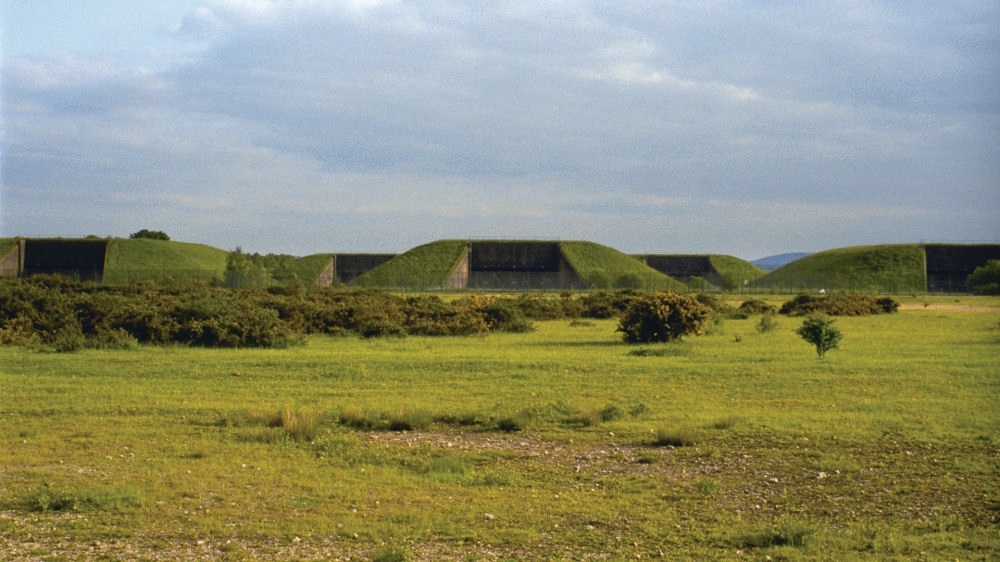
The quotation from the essay that also sticks out for me is this one:
“Ask not, ‘do you belong to this landscape?’ but ‘does this landscape belong to you?’”.
This brings her relational definitions of space together with a much deeper understanding of place. Place as dwelling and belonging. Place as a structural phenomenon determined by economics and landownership, but continually in relation with spaces being produced and reproduced by those dwelling in it. A conflict between landscapes valued for their exchange value and landscapes valued for their use value, and of whose uses. Of memory and belonging as much as of value. In one sense, the essay appealed because it was a natural confirmation of much of the spatial turn literature that I’d been wading through, while also being a challenge to it.
In the clip of the roundtable about the film at the BFI in 2010 (available here), Keiller explains how he derived ideas of place from Lefebvre alongside Heidegger, drawing on notions of dwelling and belonging, “as derived from a more settled, agricultural past”, destroyed by mobility and displacement of industrialisation. I never read Lefebvre’s work like that. I saw him much more through the lens of the poststructuralists influenced by his tripartite definition of space – as representation – rather than the deeper understanding of place as belonging and dwelling. Rather, I associated place as dwelling with early modern histories of poverty, settlement, custom and commoning, especially Keith Snell’s study of the old poor law, Parish and Belonging, and indeed E. P. Thompson’s classic books about elite power and socio-economic change in agricultural regions: Customs in Common, and Whigs and Hunters.
Indeed, these books by Snell and Thompson formed the very context for Massey’s point made on that roundtable about why they chose Speenhamland/Thatcham as a site for the film – that the 1830s were the key decade of change in Britain’s society and economy. Massey explains how the market was not a natural structure, as neoliberal economists thought or wished people to believe. The market was a social process that was created by humans and supported by elite power. The market in labour was being created in the 1830s. The acts of settlement were under challenge, as demonstrated by the Speenhamland system; the enclosure of the commons pushed inhabitants to survive solely on wage labour; and industrial regions demanded labour, compelling the labourers dispossessed from common land to move to the cities and work in the factories under neoliberal employers.
Massey drew from Polanyi in her interpretation of the effects of enclosure and the decline of the old poor law in England in the 1830s. To be honest, I never really rated the historical aspects of Polanyi’s arguments. He was a political and economic theorist above all, so his use of historical evidence was patchy. He generalised about the Tudor enclosures and I don’t think really understood the parliamentary enclosures of the eighteenth and nineteenth centuries, and certainly didn’t provide enough historical evidence for their impacts. I also perhaps align with Tawney who argued that Polanyi over-exaggerated the significance of the Speenhamland system. It was a specific workaround organised by a specific group of parishes in southern England. It was not a major form of resistance to the emergence of the liberal laissez-faire state as represented by the New Poor Law. Perhaps Speenhamland was an example of Massey’s local protectionism, but it certainly didn’t prove a popular double movement. Polanyi’s other main theory about of land, labour and money being ‘fictional commodities’ has been debunked by economists too (the argument gets rather circular so I won’t repeat it here, but in essence, if land, labour and money weren’t intended to be made for circulation in the market, as Polanyi contended, they nevertheless quickly became the main components for sale on the capital market, and therefore whether they are fictitious or not as entities is a moot point).11
Reading Polanyi reminds me of reading Charles Tilly, the historical sociologist who examined the development of social movements and protest in the eighteenth and nineteenth centuries. Tilly’s work exists in the footnotes but not the foreground of historical studies of protest. I find his work so frustrating. Like Polanyi, I agree with his big theories and his basic chronologies of change, but then looking at his methods and footnotes, there are big holes. He was both right and wrong at the same time.
Keiller’s Robinson in Ruins is along the same lines as Adam Curtis’s stock in trade, a critique of neo-liberalist capitalism brought into the state economy by Thatcher’s government and into culture by wider global movements and powers. The thesis being expounded through cut up of documentary clips, stills of landscapes, relying on the viewer to feel intelligent to join up the dots. It definitely feels (as Curtis’s work still does now) of its time.12
Watching it back now – again reminds me of the context – who was it talking to then? Post-New Labour, the 2008 financial crisis, and the start of Tory Austerity politics. That context explained the popularity of Thomas Piketty by the time I got to grips with Polanyi when I reviewed Tim Rogan’s book, The Moral Economists, in 2018 for the LRB.13 I started the LRB essay with a reference to the reading-list topper du jour, Piketty’s Capitalism in the 21st Century. Capitalism was in crisis at that point, and it seemed as if people (not sure which people, to be honest now) were looking at social history as well as economics for the solutions).
Rogan was mainly interested in the question of morality, that is, where do class-based economists and historians go next after Marxian interpretations of capitalist crisis fail to provide the answers or indeed solutions? More-than-capitalism. His answer, I think, was morality. The enduring influence of E. P. Thompson’s idea of a ‘moral economy’ of the crowd demanding a fair price and workers demanding a fair wage, mirrored in Polanyi’s faith in a double movement of institutional and popular resistance to the naked ambition of the free-market economy, and R. H. Tawney’s Christian-inflected moralism.
Well that reference to Capitalism in the 21st Century has dated that essay fast. I don’t see anyone talking about Piketty much now. I don’t read enough (read: any) modern economic theorists to know who’s hot right now in 2026. But with world events and regimes shifted so far to the right, with war ongoing in so many regions, the previous internalised ways in which we in Britain could think about austerity seem a world away. The media fuss over a lettuce to symbolise the fate of Liz Truss tanking the economy and middle-class mortgage rates was in essence a joke. But where are we now? Somewhere much more desperate and bleak.
Interlude
Go to the interlude page

More than ‘more-than-‘ histories?
Part II of the essay to be continued…
- Dare I use the current phrase ‘it hit different’… ↩︎
- History Working Papers Project was a bold attempt at a History version of ArXiv, used by scientists to post drafts of papers and crowd-source peer review before publication. It was posited as an alternative to the increasingly extractive and commercial stranglehold of the big publishers of academic journals. It’s sad it withered. ↩︎
- Hopper plays ‘Professor Parkins’ in the film We Are Making a Film About Mark Fisher ↩︎
- For a list of references to the New Political History, and to post-structuralist cultural geography, just go to my original essay. I don’t want to bore you with it all again here. ↩︎
- Sasha Handley, Rohan Williams and Lucy Noakes, New Directions in Social and Cultural History (Bloomsbury, 2018), https://www.bloomsbury.com/uk/new-directions-in-social-and-cultural-history-9781472580818/ ↩︎
- Doreen Massey and Alejandrina Catalano, Capital and Land (1978); see Isabella Pojuner, ‘The English Land Question and How Trespassers Map Epistemic Enclosure’, MA thesis, University of British Columbia, 2024, p. 20. ↩︎
- Also notable is the contrast between the two sources of funding – whereas in the 1970s, Massey and Catalano’s project for Space and Capital was part of the Wilson government funded Centre of Environmental Studies, by the 2000s, the Arts and Humanities Research Council funding was highly competitive and not directly aimed at results for government social policy – hence the contrasting themes and types of output. ↩︎
- I think she has a forthcoming “eagerly awaited sophomore effort” on foraging. ↩︎
- Janette Neeson, Commoners: Common Right, Enclosure: Common Right, Enclosure and Social Change in England, 1700–1820 (Past and Present Publications, 1993) ↩︎
- Ironically now from today’s standpoint, both institutions are tarred by corruption or multi-national investment – the Post Office postmasters/mistresses scandal hadn’t yet been revealed; and the Co-Op bank is not truly co-operative. ↩︎
- Brett Christophers, ‘For Real: Land As Capital and Commodity’, Transactions of the Institute of British Geographers, 41 (2016), 141. ↩︎
- Curtis’s most recent series, Shifty, doesn’t seem to have moved his argument forward much, in my view. It’s still “the 1970s were bad, but Thatcher’s government made everything even worse”. I mean, that’s true, but what’s really the message for today’s politics? ↩︎
- See Margaret Somers and Fred Block, ‘Polanyi’s democratic socialist vision:
Piketty through the lens of Polanyi’, in Radhika Desai and Kari Polanyi Levitt, eds, Karl Polanyi and Twenty-First-century Capitalism (Manchester University Press, 2020) ↩︎
Bibliography
Desai, Radhika and Kari Polanyi Levitt, eds, Karl Polanyi and Twenty-First-century Capitalism (Manchester University Press, 2020)
Koole, Simeon and Ben Mechen, ‘Bodies, Tides, Timber and the Global History of London’s Docks, 1860-1928’, Past & Present, early view (2025), https://doi.org/10/1093/past/gtaf025
Ozkan. D and B. G. Baykal, eds, Commoning the City: Empirical Perspectives on Urban Ecology, Economics and Ethics (Taylor and Francis, 2020)
Shepherd, Edward, and Matthew Wargent, ‘Embedding the Land Market: Polanyi, Urban Planning and Regulation’, Environment and Planning, A, Economy and Space (2024), 905-26, DOI: 10.1177/0308518X231203484
Snell, Keith, Parish and Belonging: Community, Identity and Welfare in England and Wales, 1700-1950 (Cambridge University Press, 2009)
Leave a Reply