More than ‘more-than-‘ histories?
This is part II of my essay More than More than Space. Read that first, then come back here.
In the previous part, I recalled how I wrote Why I am Tired of Turning in the aftermath of the onslaught of ‘turns’ in political and social history. I turned to cultural and historical geography, their studies of popular resistance and movement, which were often influenced by Doreen Massey’s work.
Polanyi’s analysis has been termed ‘more-than-capitalist’.1 In a post-Marxist age, his analysis of the rise and potential fall of capitalism, with its promise of a double movement that doesn’t necessarily require revolution, but offers a vision of mutual aid and co-operation, perhaps seems appealing. I’m less keen, as are many critics, on his disembedding of the market, removing the role of capital from lived experience of workers.2
‘More-than’ is another key phrase that denotes a theoretical framework that often starts off as useful, has elasticity to encompass more fields, then is stretched so far to cover everything as to lose all capacity for explanation.
<edit> Aug 2026:
One thing that I learned from the training for trade union branch officers offered by my Regional Office of UCU, in a course on collective bargaining and negotiation, is that everything is connected. No one single decision is made in isolation. However un-connected, or rationally disconnected, an event or an edict or a rule-change may appear, it is always connected to other decisions, policies and agendas. Everything, from the smallest to the largest change, is connected and part of a wider framework or ideology or structure.
Neo-liberalism, despite however much it would like to, is never isolated from the structures in which it operates or influences. Polanyi used ’embeddedness’ as a metaphor for economic behaviour that sits within social, political and cultural relations. As Shepherd and Wargent (2024) note:
For Polanyi, [embeddedness] served as a corrective to perceptions of laissez-faire classical liberal economic thought that stressed the desirability of an autonomous self-regulating market economy that was conceptually distinct and could be ‘disembedded’ from such relations.3
The 18th and 19th century political economy attempts to ‘disembed’ the economy from society and politics were, therefore in Polanyi’s model, forcible but flawed. The market and the state could never be totally separate and autonomous.
Everything is connected and relational. Again I point to Doreen Massey’s definition of space as relational and not a fixed thing, but continually being produced by the relations of society and the economy. The Rural Modernists are starting to think about these frameworks and concepts in terms of the environment.
Cultural geographers have done this process of relational connections, for years, drawing from post-structuralist theory rather than Polanyi or Gramsci.
</end>
Cultural geographers regularly discuss ‘more than human’ agencies in events and change.4 A dominant framework has been Actor-Network Theory (ANT), that now rather nebulous way of understanding the relationship between nature and humans, in which the agency of nature is foregrounded before human action and intervention.5
The keywords of ANT discourse include ontology, or the materiality of objects. Materialism is less of an economic superstructure as an interaction with the natural and built environment as shaped by humans. It all gets a bit much. I don’t think historians are entirely sure what ontology is after all.
ANT has not dominated debates in historical scholarship. Historians tend to shy away from theory and theoretical frameworks altogether. Empirical archival research is usually presumed to speak for itself. The sorts of studies that get prioritised for REF, for example, are footnote-heavy, archival rich, but ostensibly theory lite. Time in the county record office with the scribbled handlist of archives is worth more, apparently, than time in the library with Deleuze and Guattari or Bruno Latour.
Pylons
In around 2017, I was drawn into the 20th century starting up the Rural Modernism research network. I knew most of the historians through different channels – colleagues I’d known for ages as protest historians, or friends of colleagues. We were all searching for lively intellectual discussion outside the confines of an increasingly bureaucratised academy. We decided to enact some praxis, “joy as an act of resistance.”
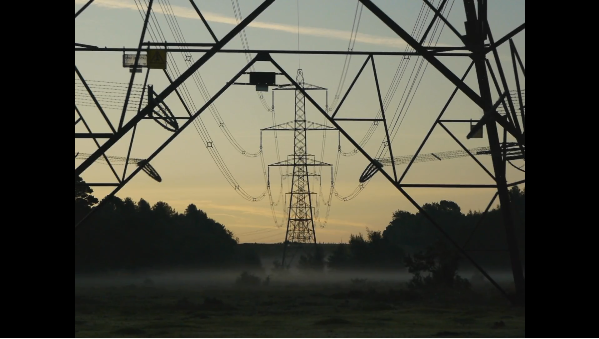
We were interested in pylons.

Or at least what pylons represented. Pylons, power stations, nuclear atomic, dams, hydro-electric dams, military sites, transmitter towers, concrete. The scale was regional – the National Parks from 1949, the TV broadcasting regions, the regional Electricity Boards. The politics was socio-democratic.
Rural Modernism’s projects centred on the impact of the nationalisation of the energy industries in Britain in the mid 20th century, and especially the building of mass infrastructure in the rural environment.6
Who were we talking to in 2017-19? We were in dialogue with various groups of historians, geographers, landscape architects and architects interested in mid 20th century modernism. One group were the ‘SPUD’ network of urban historians in the universities of Birmingham/Warwick and the nexus around Simon Gunn and Peter Mandler, including Otto Saumarez Smith among a host of upcoming urban scholars. These urban historians are interested in the mid century modern as an urban aesthetic and ideal for living. The modern(ist) habitat was the utopia.
Their work came alongside a reappreciation of the mid-century welfare state and especially its housing programme from contemporary writers, notably John Boughton in his wonderful Municipal Dreams blog and book reappraising the history of council housing, and the exemplary writing of Owen Hatherley on all things urban socialist planning and architecture. The rise of The Modernist Society, led by the indefatigable Eddie Rhead and Jack Hale, and their magazine The Modernist, seemed to shape and epitomise the coolness of being into mid century modernism. I even wrote for the magazine, on bins, naturally (as well as my beloved Lucy’s electrical boxes…).
This was thrilling, exciting. This was who we began talking to.
An increasing number of historians also were interested in the same nationalised state infrastructures and rural themes as us – scholars at Manchester Metropolitan University and Liverpool University were equally obsessed with power stations, dams, motorways, and the role female landscape architects (Nan Fairbrother; Sylvia Crowe), but from more of an architectural and aesthetic angle.
We all converged in a shared revival of research into the rural mid-20th century, with projects funded by the AHRC Landscape Decisions scheme, including our own Decommissioning the 20th Century and Planning Creativity projects, as well as interesting work by Jeremy Burchardt and others on landscape writing. It was great to have that concentration of activity.
Fawley, a film produced by Chu-Li Shewring and Adam Gutch, was perhaps the finest output from the Decommissioning the 20th century project. It won best short doc at Sheffield DocFest 2022. It is a collage of oral histories of workers and residents at the Fawley oil refinery and power plant, on the Solent, with reflections on its demolition. It’s very much in the mode of the hauntological landscapes evoked by Ghost Box records, The Detectorists, and landscape writing that also looked back somewhat nostalgically to memories of the mid 20th century.
I hope you like it:
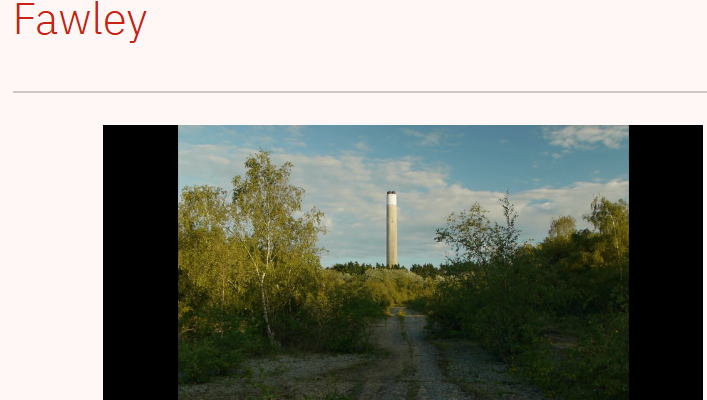
Fawley, a film by Chu-Li Shewring and Adam Gutch: https://fawleyfilm.co.uk/
More than more than mid century modern
Recently, the modern urban historians have produced a new edited book, the lavishly produced The Modern British City, 1945-2000, ed. Simon Gunn, Peter Mandler and Otto Saumarez Smith (Lund Humphries, 2025).
It is great. It is just what you want if you want to read about mid century British urban architecture and urban life. It is a culmination of sorts of this strong field of urban history. It is “Now That’s What I Call Modernism”.
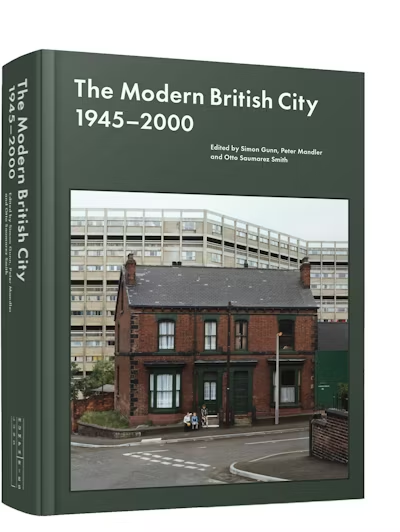
I went to the book launch at Senate House, London. Many of the authors were on the panel, or in the audience, among the great and good of urban history, architecture and planning. Owen Hatherley commanded the room when he spoke. It was for sure a celebration of what they’ve achieved.
Two things got me thinking.
Number one was Otto Saumarez Smith’s summary of his excellent chapter in the book. There was an acknowledgement by Peter Mandler that the book should be called the modern British town, as the book doesn’t solely focus on cities, but the publisher thought the title would sell more. Notably Otto’s chapter, and how he described it, is a rallying call to move away from the previous attention given to the classic mid century modern city tropes and look towards a more mundane everyday of urban life in Britain.
So move away from the recurrent references (like an Instagram influencer ticking off the list: Park Hill Sheffield and ‘streets in the sky’; Goldfinger’s Balfron Tower, or rather, his house in Willow Road; the Barbican estate; Le Corbusier’s Cite Radieuse/Unite d’habitation, Marseille; etc etc. Even Milton Keynes, with its white heat of technology modernism, and scuppered plans for monorails. Yes, I’ve been to them all, and enjoyed them all. Yes I wish more buildings were like these. I strongly yearn for a return to the age of a mass housing project and a functioning welfare state. Modernism for all.
But as Otto pointed out, most people didn’t live in a modernist utopia, or even in the buildings we reify as enacting their ideal. Most people lived in a much more mundane suburbia. In the new towns, yes, with their low-key modernism and Radburn-style layout of housing. But most British people lived in small towns, in mass housing with not much architectural innovation or merit:
Most urban places in Britain don’t look like Park Hill, or the Barbican, or Milton Keynes, or Cumbernauld. We need post-war urban histories of, inter alia, Chesterfield, Crewe, Derby, Dudley, Folkestone, Grimsby, Hartlepool…7
Indeed, Otto cites Doreen Massey in his conclusion, noting her insight (most likely drawn from experience from Wythenshawe):
Amid the… Baudrillard visions of hyper space … most people actually live in places like Harlseden or West Brom. Much of life for many people … still consists of waiting in a bus shelter with your shopping for a bus that never comes.8
Perhaps this malaise with reifying the mid century modern is why I’m intrigued by characters harking back (perhaps hauntologically) to the seedier side of the 1970s and their characters and pre-gentrified neighbourhoods. I’m thinking of the persona woven by Lias Saoudi, with its references to Mark E. Smith and Lee Brilleux. Or more recently, the semi-Meades/semi-Jeffrey Bernard character portrayed by Jimmy Mac, the ‘Dead Pubs’ guy taking social media viewers through tours of the less salubrious pubs of boroughs of London such as Deptford, where echoes of those old dirty coal-filled oil-filled neighbourhoods of the capital still haunt the un-gentrified buildings. Not co-incidentally, both men play their part in a beige mac and loose tie.
Notably, I would put The Modern British City alongside a companion volume, equally beautifully produced, Excavate! The Frightening World of the Fall, ed Tessa Norton and Bob Stanley (Faber, 2021).
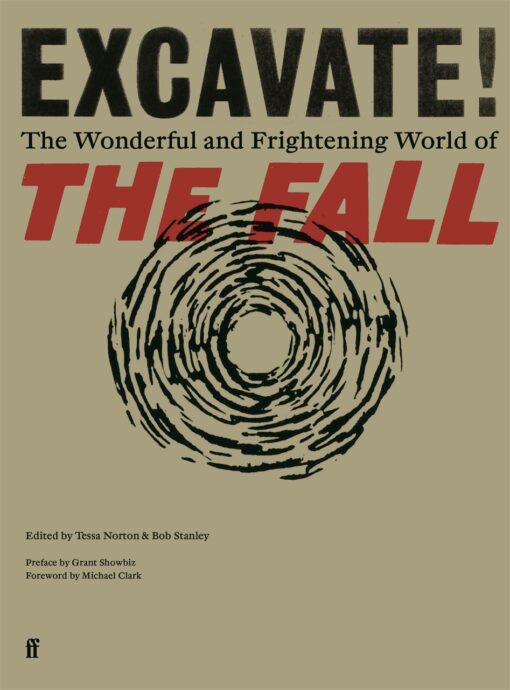
The late Elain Harwood connects the two in terms of modernism (although NB Owen Hatherley superbly has an essay in both books). Her essay ‘Jerusalem to Prestwich’, considering the threads of Blake’s Jerusalem, and less its dark Satanic mills and more Blake’s vision of ruins. She linked Blake to Smith through the smoke-blackened architecture of dark decaying Prestwich, and the dingy pubs of Joseph Holt and Co, which, she argued, was more resonant of the realities of living in the city, or rather its conglomoration of old Lancashire towns, than any post-factory, post-Factory, Manchester redevelopment ever was.9
Back to my number two thought at the launch of The Modern British City. A man on the front row asked a question. He wasn’t one of the great and good of architecture history. He said he lived in a council block, and always had done, and was wondering about what all this means now, for those dealing with the aftermath of the mass privatisation of council housing and the exclusion (or in David Harvey/Brett Christophers’ terms, accumulation by dispossession) of former council tenants by multi-national developers in the ‘regeneration’ of inner-city estates.
Of course, the book does deal with the history of privatisation and regeneration and also homelessness. But the question did make a point about what is the point of thinking about mid century urban history now.
The Rural Modernists, after a hiatus after the lockdown and our own projects, are reconvening. Our conversations have moved onto a private Whatsapp group, like many formerly open academic salons that formerly used the old Twitter but now retreated back to a world of who-you-know. And we realised that we’re not talking directly with the urban history groups any more. We love their work, but that’s not where we’re at any more.
So who am I attempting to talk to now?
The Rural Modernists have gone environmental.
Labour history has, in effect, disappeared as a recognisable field in British history. Before the good folks of the Society for the Study of Labour History furiously denounce that statement, of course it still exists. I know that there is solid and continuing work undertaken by historians of trade unions and labour struggles. But the field, as it once was, is now small.
I was recently browsing through the staff and PhD student list of a major history faculty. It allowed you to filter scholars by a drop-down list of categories of fields of history – cultural, disability, LGBTQ+, architectural, gender, political, global, etc. But there is no labour history on the list.

Screengrab of categories of history.
Yet there are histories of labour, workers’ experience and collective action in many of those categories. It’s just hidden.
Where is the materiality or the materialism?
Are we beyond the ‘more than’? Empirical historians would no doubt underline the ‘more than’ in any such sentence and ask what does that really mean? Do we just mean non-human? Where is the materiality and materialism in such explanations of agency?
There is an answer. I’m finding it in new work that originates from environmental histories but also intersects with work that would not overtly describe itself as labour history. This work is in the field of histories of post-industrial Britain and Europe, or studies of de-industrialisation. This is an obvious route for me and the Rural Modernism group, who had explicitly been discussing the history of nationalisation of industries and then their decommissioning in the 20th century.
I’m therefore interested in the work of Ewan Gibbs on late 20th century Scottish energy industries and deindustrialisation.10 Gibbs draws from a wide range of theory (including Bourdieu’s structures of feeling for understanding workers’ experience of deindustralisation and collective action). Notably his earlier work harked back to Polanyi’s double movement and Thompson’s moral economy in his study of Scottish deindustrialisation.11
Though not overtly termed as such, studies of deindustrialisation and the environment are in essence a revival of labour history, hopefully in its best forms. They examine physical and environmental impacts on the labouring body, on individuals’ lived experiences, and on collective labour. It does so, importantly, within a materialist structure of capital and state power. The human-first tradition of labour history is maintained, but often such studies start with the environment first.
I’ve also recently been inspired by Simeon Koole and Ben Mechen’s recent article in Past & Present, which is an environmental history of East End dockworkers. Koole and Mechen argue for the integration of what they call ‘lines of force’12:
“Invisible threads connecting the body to forces beyond it and the physical traces making these threads tangible lines of spatial and temporal connection and their material effects.”
They call for historians to examine materiality (impacts of physical environment on the human body) within contexts of longer timescales such as global environmental change (other-than-human) that was increasingly shaped by humans through industrialisation and intensified commodification. Trees or fossil fuels, for example, grew at different scales and chronologies, but were impacted at particular points by human actions such as extraction and global trade, which in turn impacted working conditions and wages.
Drawing on Christian de Vito’s notion of ‘history without scale’,13 they argue for history writing to be phenomenological global histories, linking the local to the global. Such lines of force therefore defined a:
“local, historically specific experience of precariousness that was nonetheless geographically distributed, multi-temporal and multi-scalar.”
Historians really need to think this way too. It doesn’t involve being dragged down into archival quagmires Annales-style, but rather being aware that a place in time and a point in time and a body in time are all connected to multiple timescales and multiple geographies, the links to which and between we should explore. And this is more than mere assemblage, Deleuze-light, but rather is structural. Economies, power structures and elites shape those connections, exploit those landscapes and commodities, and the bodies that extract them.
Radical histories and geographies emphasize intersectionality and reshifting the imbalance of voices and stories, often with attention to land struggles and environmental resistance. This approach integrally shifts the focus back to questions of labour, property and capital.
Go to my ‘Interlude’ on culture next.
- Jamie Peck, ‘Disembedding Polanyi: Exploring Polanyian Economic Geographies’, Environment and Planning A: Economy and Space, 45(7) (2013), 1536-1544, https://doi.org/10.1068/a46253; Edward Shepherd and Matthew Wargent, ‘Embedding the land market: Polanyi, urban planning and regulation’, Environment and Planning A: Economy and Space, Volume 56, Issue 3 (2024), 911, https://doi.org/10.1177/0308518X231203484 ↩︎
- See Tim Strangleman, ‘Deindustrialisation and the Historical Sociological Imagination: Making Sense of Work and Industrial Change’, Sociology, 51, no. 2
(2016), 466–482, and Gibbs, n10 below. ↩︎ - Edward Shepherd and Matthew Wargent, ‘Embedding the Land Market: Polanyi, Urban Planning and Regulation’, Environment and Planning A, 56: 3 (2024), 906. ↩︎
- Susan Whatmore, ‘Materialist returns: practising cultural geography in and for a more-than-human world’, Cultural Geographies, 13(4) (2006), 600-609, https://doi.org/10.1191/1474474006cgj377oa; Carlotta Molfese, ‘Towards a more-than-human theory of resistance: reflections on intentionality, political collectives and opposition’, in S. M. Hughes, ed., Critical Geographies of Resistance (Edward Elgar Publishing Limited, 2023) ↩︎
- Ignacio Farías and Thomas Bender, eds, Urban Assemblages: How Actor-Network Theory Changes Urban Studies (Oxford: Taylor & Francis Group, 2009). ↩︎
- Our main published output is our edited collection, Linda M Ross, Katrina Navickas, Matthew Kelly and Ben Anderson (eds), New Lives, New Landscapes Revisited: Rural Modernity in Britain (London, 2023), https://doi.org/10.5871/bacad/9780197267455.001.0001. It’s an ode to Nan Fairbrother. Our other regular members include Ian Waites, Iain Robertson, Marianna Dudley, Moa Carlsson, and – token but very welcome medievalist, Leonie Hicks. ↩︎
- Otto Saumarez Smith, ‘Scrambled Cities’, in The Modern British City, 1945-2000 (Lund Humphries, 2025), p. 395. ↩︎
- Doreen Massey, ‘A Place Called Home?’, New Formations, 17: 3 (1992), 3-15, republished in https://www.cambridge.org/core/books/abs/doreen-massey-reader/place-called-home-1992/445FF56A4CC63F7D0324DC7B996EA999 ↩︎
- Elain Harwood, ‘Jerusalem to Prestwich’, in Tessa Norton and Bob Stanley, eds, Excavate! The Wonderful and Frightening World of The Fall (Faber, 2021), pp. 17-34. ↩︎
- Ewan Gibbs, Coal Country: The Meaning and Memory of Deindustrialization in Postwar Scotland (University of London Press, 2021), http://www.jstor.org/stable/j.ctvz0hcgs ↩︎
- Ewan Gibbs, “The Moral Economy of the Scottish Coalfields: Managing Deindustrialization under Nationalization c.1947–1983,” Enterprise & Society 19, no. 1 (2018): 124–52 ↩︎
- Simeon Koole and Ben Mechen, ‘Bodies, Tides, Timber, and the Global History of London’s Docks, 1860–1928’, Past & Present, 2025, gtaf025, https://doi.org/10.1093/pastj/gtaf025 ↩︎
- Christian G De Vito, ‘History Without Scale: The Micro-Spatial Perspective’, Past & Present, Volume 242, Issue Supplement_14, November 2019, Pages 348–372, https://doi.org/10.1093/pastj/gtz048 ↩︎